
Article tag: female urogenital model procurement| BIX-A1089| urology teaching model| gynaecology anatomy model|
A urogenital model is worth its bench space only if it answers the questions your course actually asks. The BIX-A1089 answers the anatomical ones well: it shows the kidney, ureter, uterus, vagina, uterine artery, ovarian adnexa and round ligament in a single unit, made from PVC on a base, listed at US $27.1 with ISO and CE certification noted on the page.
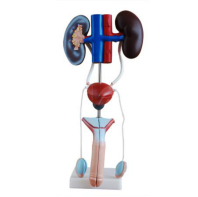
| Item | Detail |
|---|---|
| Model | BIX-A1089 |
| System | Female urogenital |
| Structures shown | Kidney, ureter, uterus, vagina, uterine artery, ovarian adnexa, round ligament |
| Material | PVC, mounted on a base |
| Listed price | US $27.1 |
| Certification | ISO and CE noted on the product page |
| Typical buyers | Nursing and midwifery schools, urology and gynaecology departments, anatomy labs |
The listing is specific about its teaching purpose: it is intended to help students understand the shape of the main organs of the female urogenital system and their internal structure, using the model as a visual aid during instruction.
Four relationships make it useful in a course:
The ureter's course. The ureter passes close to the uterine artery and behind the broad ligament — the anatomical fact behind the classic warning about ureteric injury during pelvic surgery. A model that shows both structures together lets an instructor point at the crossing rather than describe it.
The uterus and its supports. Round ligament, ovarian adnexa and uterine artery appear in relation to the uterus, which is what a student needs in order to understand prolapse and its surgical correction.
Kidney-to-bladder continuity. Showing the upper and lower urinary tract in one unit supports teaching about reflux, obstruction and catheterisation consequences.
Vaginal and uterine continuity. Relevant to midwifery teaching, speculum examination, and understanding of ascending infection.
Nursing and midwifery. The model supports urinary catheterisation teaching (where the catheter goes and why), postpartum assessment, and infection control discussions. It is a low-cost, unbreakable reference that can sit on a skills bench rather than in a cabinet.
Urology and gynaecology. It is a reference model for pelvic anatomy briefings, useful before theatre lists and in consent discussions with trainees. It is not a procedure simulator.
Anatomy departments. A useful station model for the genitourinary block. Paired with a sagittal torso or pelvis model, it covers both the system view and the cross-sectional view.
The literature on urogenital anatomy teaching emphasises functional relationships rather than isolated structure naming: work on urogenital hiatus closure describes the perineal complex as a triad whose function depends on the interaction of its parts [1], and cadaveric studies of urogenital fascia continue to revise what students are taught about the inguinal region [2]. A model cannot reproduce that complexity, but it can anchor the names to positions — which is the prerequisite for understanding the function later.
It is a static PVC anatomical model. It does not simulate catheterisation, does not accept instruments, and does not show pathological states. If your course assesses catheter insertion, buy a dedicated catheterisation trainer; if it assesses pelvic examination, buy a pelvic examination simulator.
Because the material is PVC, cleaning matters: use a soft cloth and mild detergent, avoid solvents, and store covered to prevent the painted structures dulling.
Q1. Which structures does the BIX-A1089 show?
The kidney, ureter, uterus, vagina, uterine artery, ovarian adnexa and round ligament, in PVC on a base.
Q2. What does it cost?
US $27.1 per unit as listed on the product page; confirm current pricing, packing and freight with the supplier.
Q3. Is it CE certified?
The product page notes ISO and CE certification. Request the certificate documents if you need them for a tender file.
Q4. Can it be used for catheterisation training?
No — it is an anatomical model. Use a catheterisation trainer for that skill.
Q5. Is it suitable for midwifery teaching?
Yes for anatomy and pelvic organ relationships. For birth mechanics and examination skills, pair it with a dedicated obstetric trainer.
Q6. How do we place an order or request a sample?
Email cprmodel@adaanatomy.com with the quantity, your city and any tender documentation requirements.
For the specification sheet, certification documents and a landed-cost quotation: cprmodel@adaanatomy.com. Production follows ISO 45001 management practice; CE documentation available for EU procurement.