
Article tag: ADA-403C dental care model| 32 teeth model| dental hygiene teaching model| tooth brushing demonstration|
Dental care model ADA-403C — full 32-tooth arch with gums, tongue and palate, toothbrush included; for oral hygiene teaching in clinics and schools.
...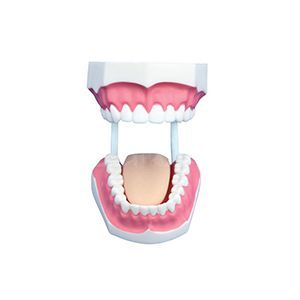
Short answer: ADA-403C is a small dental care model with 32 teeth, made of PVC. The page states that it consists of gum, teeth, tongue and palate, demonstrates tooth form and oral cavity cleaning and protection, and comes with a toothbrush. Its size is 11.3 x 17 x 10 cm. It is a demonstration model for oral hygiene teaching — it is not a typodont for cavity preparation.
Key takeaways
| Item | Published detail |
|---|---|
| Model | ADA-403C |
| Category | Teeth Models |
| Teeth | 32 |
| Material | PVC |
| Components | Gum, teeth, tongue and palate |
| Accessory | Toothbrush included |
| Size | 11.3 x 17 x 10 cm |
| Intended use | Demonstration of tooth form and oral cavity cleaning and protection |
| Price | Not published — quotation required |
Most brushing demonstrations use a partial model, which hides the two places decay actually starts: the distal surface of the last molar and the lingual surface of the lower incisors. A full 32-tooth arch puts both in view. The included tongue and palate also let a teacher show why the brush has to reach behind the last tooth without triggering a gag reflex.
The material matters for the lesson, not for the surgery. PVC wipes clean between demonstrations and tolerates repeated brushing with a dry brush. It does not simulate enamel, dentine or caries, so the model is the wrong tool for teaching cavity preparation — and the page does not claim otherwise.
| Published feature | What it lets you demonstrate |
|---|---|
| 32 teeth | The full adult arch, including third molars and the distal surfaces behind them. |
| Gum | The gingival margin and the 45-degree brush angle that cleans it without trauma. |
| Tongue and palate | Cleaning the tongue and the palatal surfaces of the upper teeth. |
| Toothbrush included | A complete demonstration set out of the box. |
| 11.3 x 17 x 10 cm | Hand-held demonstration; the patient can hold it while copying the movement. |
| PVC | Wipe-clean between patients or classes. |
Dental teaching has moved toward models that make an abstract surface concrete. A 2026 study of multidimensional training in dental anatomy teaching reported that combining physical models with structured exercises improved students' identification of tooth morphology [1]. A 2026 evaluation of 3D-printed models in tooth morphology training found a measurable gain over slide-based teaching, with the physical model doing the work that images could not [2]. A 2026 paper on edentulous models adds a caution that applies here: a model teaches only the task it was designed for, and students will over-generalise if the boundary is not stated [3].
| Not stated on the page | Question to ask |
|---|---|
| Whether teeth are individually replaceable | A chipped incisor should not retire the whole model. |
| Cleaning and disinfection guidance | PVC can be damaged by alcohol-based products; confirm the agent. |
| Colour options | Some clinics prefer a neutral gum colour for patient education. |
| Package size and weight | Not published; needed for bulk orders to schools. |
| Price at quantity and lead time | Quotation item — school orders are usually multi-unit. |
Email cprmodel@adaanatomy.com with the model ADA-403C and the number of classrooms you supply, and we will send the cleaning guidance, carton data and quantity pricing together.
Q1. What is ADA-403C?
A small dental care model with 32 teeth, used to demonstrate tooth form and oral cavity cleaning and protection.
Q2. What is included?
Gum, teeth, tongue and palate, plus a toothbrush. The model is made of PVC and measures 11.3 x 17 x 10 cm.
Q3. Can it be used to teach brushing?
Yes. The full arch, gum line and included brush are designed for that demonstration.
Q4. Is it suitable for cavity preparation practice?
No. The page describes a demonstration model for cleaning and protection, not an operative typodont.
Q5. How do I clean it?
The page does not specify a cleaning agent. Ask the supplier before using alcohol-based wipes on PVC.
Q6. How do I get a price for a school order?
Email cprmodel@adaanatomy.com with the model (ADA-403C), the number of units and your city, and ask for carton data and quantity pricing.
Write to cprmodel@adaanatomy.com for the ADA-403C specification sheet and a quotation. If you run a school oral-health programme, ask in the same email about the larger demonstration models and the replacement brush supply, so the kit survives a full term.