
Article tag: BIX-LV40| ear washing model| ear syringing trainer| ear canal irrigation practice| nursing ear care |
How to teach ear syringing safely on the BIX-LV40 model: water temperature, angle, flow and the checks that prevent a real-world injury.
...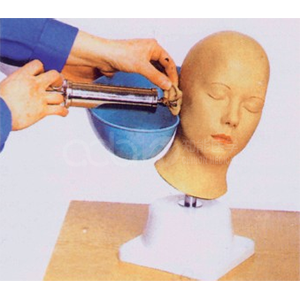
Quick answer. The BIX-LV40 is a head model designed for practising ear canal irrigation and syringing. Its purpose is straightforward: let students learn the angle, the flow and the patient positioning on a model instead of washing a patient's ear for the first time.
Ear syringing looks simple and is easy to do badly. Water that is too cold causes vertigo and nausea; a jet aimed at the tympanic membrane can be painful; a missed contraindication — perforation, a history of ear surgery, a discharging ear — turns a routine procedure into a referral. None of that is learnable from a photograph.
| Teaching element | On the model | Transfer to practice |
|---|---|---|
| Head positioning | Model head on a stand, ear accessible | Correct patient posture and head tilt |
| Irrigation angle | Posterior-superior wall aiming | Avoiding direct impact on the tympanic membrane |
| Flow control | Syringe or irrigation device practice | Pressure control and steady delivery |
| Catch basin | Fluid collection during practice | Managing spillage and patient comfort |
| Sequence | Full procedure rehearsal | Consent, checks, aftercare instructions |
Before any irrigation, the student must be able to state:
Nursing literature on ear syringing and aural care treats these as core competencies rather than optional detail, and the procedure is routinely delegated to nurses and audiologists who must be assessed on them [1][2]. Cerumen management practice studies show wide variation in technique between services, which is precisely the argument for standardised training on a model before practice [3].
Record the attempts. A model session is only worth the time if it produces a checklist score that can be compared with the clinical sign-off later.
Quotation. Price, stand specification and cleaning guidance for the BIX-LV40 are available from cprmodel@adaanatomy.com; state how many students practise per session so the number of units can be sized.
Q1. What is the BIX-LV40 used for? Practising ear canal irrigation and syringing on a model head, so students learn angle, flow and positioning before treating patients.
Q2. Does it include both ears? Confirm with the supplier for the batch you order; the model is designed for ear-washing practice on an accessible ear canal.
Q3. Can it simulate wax removal? No. It trains the irrigation procedure, not cerumen removal or the sensation of a blocked canal.
Q4. Is it suitable for nursing assistants or only registered staff? It suits any programme where ear irrigation is in scope, provided the contraindication checks are taught and assessed.
Q5. How should it be cleaned? Wipe and drain after each session according to the supplier's instructions; the unit is used wet, so dry it fully before storage.
Q6. What must students learn before using it? Contraindications, water temperature, safe irrigation angle, controlled pressure, consent and escalation criteria.
Product page: BIX-LV40 Ear Washing Model: Teaching Ear Syringing Without a Patient — specification, packing data and a quotation request form.
For a quotation on the BIX-LV40 ear washing model, write to cprmodel@adaanatomy.com.