
Article tag: BIX-Y1018| 40 cm ear acupuncture model| auricular model sizes| ear model for teaching| TCM classroom|
13 cm, 40 cm or life-size ear model? A size-by-size comparison for lecture halls, skills labs and student self-study, with a buying rule.
...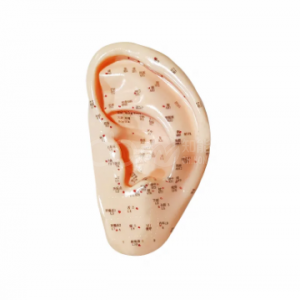
Quick answer. The BIX-Y1018 is a 40 cm enlarged ear model in PVC, with auricular points mapped to viscera and body regions and a pamphlet describing the points. It is the demonstration size in a series that runs from 13 cm student models to a life-size ear. Buy the 40 cm for the lecture wall, the 13 cm for student hands, and the life-size for clinical realism — they solve different problems.
Department heads usually ask one question: which size should we order? The answer depends on who is looking and from how far. This is a short, practical comparison based on the three roles an ear model plays in a TCM programme.
| Size | Typical model | Viewing distance | Best use | Weakness |
|---|---|---|---|---|
| 13 cm | BIX-Y1016 and similar | Arm's length | Student self-study, pair drills, exams | Unreadable beyond two rows |
| 40 cm | BIX-Y1018 | 6–8 m | Lecture demonstration, wall display, video recording | Too large for desk work |
| Life-size | BIX-Y1015 | Arm's length | Clinical realism, patient explanation | Points crowded; poor for beginners |
At 40 cm the auricle is roughly six times life-size. That enlargement does two things. First, point clusters that overlap at 13 cm — the concha and the tragus region in particular — separate enough to be pointed at individually. Second, labels can be printed large enough to photograph, which matters because most students now revise from phone photos rather than from the model itself.
The practical benefit shows up in video-recorded teaching. A 40 cm model fills a camera frame at a comfortable distance, so a recorded lecture remains legible when compressed for an LMS. A 13 cm model requires a macro shot, and the resulting video is unusable on a phone.
Students learn point location faster when they understand why the points are used. Auricular acupressure has been evaluated in controlled settings for sleep in haemodialysis patients, with measurable effects on insomnia scores [2], and combined auricular protocols have been studied in nursing populations for salivary flow and comfort outcomes [3]. These are treatment studies, not anatomy studies, but they give the map a purpose: students who know which points carry evidence practise location more carefully than students memorising a chart.
A note of caution for teaching integrity: the mechanism literature on auricular stimulation is dominated by vagal-nerve work, and the anatomy of auricular innervation is the honest explanation for why the ear is used at all [4]. Teach the anatomy, present the clinical evidence as emerging, and avoid overclaiming.
Quotation. Pricing for the BIX-Y1018 and the matching 13 cm and life-size models is available from cprmodel@adaanatomy.com; tell us how many teaching rooms you equip so the mix can be costed as one order.
Q1. How large is the BIX-Y1018? 40 cm, an enlarged model intended for classroom demonstration rather than individual study.
Q2. Does it include a point chart? Yes. A pamphlet describing the auricular points is supplied.
Q3. Can it be wall-mounted? It is a display model; ask the supplier about the base or mounting option you need before ordering.
Q4. Is 40 cm accurate enough for exams? Use it for demonstration and viva questions. For student practical exams, the 13 cm model at arm's length is a fairer test of location skill.
Q5. What material is it made of? PVC, with painted or printed point markings. Clean with a soft damp cloth and avoid solvents.
Q6. Do you supply the smaller sizes? Yes. The series includes 13 cm and life-size ear models, plus foot and head acupuncture models in the same style.
Product page: 40 cm vs 13 cm vs Life-Size: Choosing an Ear Acupuncture Model Size — specification, packing data and a quotation request form.
For a size-mix quotation covering the BIX-Y1018 and the 13 cm student model, write to cprmodel@adaanatomy.com.