
Article tag: BIX-A2129| cardiac circulation model| electric heart model| cardiac cycle teaching| heart physiology|
BIX-A2129 review: what an electric circulation model adds to cardiac physiology teaching, where animation helps, and where it quietly creates misconceptions.
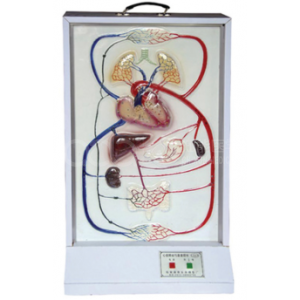
...
Cardiac physiology is the point in the curriculum where students stop trusting their intuition. They can label the chambers and still be unable to explain why the left ventricle is thicker, or what "isovolumetric" means in practice. Static models do not fix this, because the subject is a sequence.
The BIX-A2129 is an electric model: it demonstrates the basic principle of blood circulation and the cardiac cycle by showing a heartbeat and blood circulation. The question for a buyer is whether a driven, animated heart teaches better than a diagram and a lecturer's hand.
| Teaching point | What a driven model can show | What it cannot show |
|---|---|---|
| Chamber sequence | Order of contraction, atria to ventricles | Pressure–volume loops |
| Valve timing | Opening and closing relative to the beat | Murmurs and stenosis |
| Circulation route | Pulmonary and systemic paths | Actual flow rates |
| Cycle phases | Systole and diastole as a repeating sequence | Isovolumetric phases at molecular detail |
| Rate change | Faster or slower rhythm, if adjustable | ECG morphology and arrhythmias |
That first row is the reason to buy it. Sequence is exactly what a static model flattens, and sequence is what students are examined on.
A visible, repeating beat gives students a referent they can point at. When an instructor says "diastole is longer than systole at rest", the model can be stopped and the two phases counted. That is a small thing that changes how a lecture lands.
Physiology teaching has moved in this direction deliberately. A mathematical computer simulation of cardiac excitation–contraction coupling was used to teach the link between electrical events and contraction, precisely because the sequence is hard to hold in working memory [1]. Augmented-reality instruction produced better comprehension of cardiac physiology than conventional teaching in an undergraduate cohort [2]. The common thread is not the technology — it is that the sequence is externalised, visible and repeatable.
An electric model is the low-tech end of that spectrum: no software, no headset, no update cycle. For a lab that wants one durable demonstrator, that simplicity is an advantage.
It makes the heart look like a pump with a single speed. Real cardiac output responds to preload, afterload and contractility. A model that beats steadily can leave students with a fixed-output mental model. Davis described a dynamic cardiac pump simulation built specifically to teach those determinants [3]; a simple demonstrator does not replace that lesson, and the instructor should say so.
Blood appears to flow because a light moves. Students may over-read the animation as evidence of pressure gradients. Narrate the pressure story explicitly, or the model teaches plumbing instead of physiology.
Rhythm looks regular. No arrhythmia, no ectopic beat, no conduction block.
Step 5 is the one that turns a demonstrator into a teaching tool. A model that is never criticised in class becomes an authority; a model that is deliberately broken becomes a scaffold.
For a course that needs one visible, durable demonstration of sequence and circulation, the BIX-A2129 does the job and does it without software. For teaching pressure–volume relationships, output regulation or arrhythmias, it is the wrong instrument, and buying it as a general-purpose heart model will disappoint.
Buy it for sequence; teach the rest with cases, simulation and bedside physiology.
Quotation and specification. Pricing, voltage options and delivery for the BIX-A2129 are available from cprmodel@adaanatomy.com.
Q1. Is the BIX-A2129 battery powered or mains powered? The listing describes an electric model but does not state the supply type. Confirm voltage and adapter requirements before ordering.
Q2. Does it show both pulmonary and systemic circulation? It is specified to demonstrate the basic principle of blood circulation and the cardiac cycle, which includes both circuits. Confirm the vessel labelling on the actual unit.
Q3. Can the heart rate be adjusted? This should be confirmed with the supplier; the listing describes a shown heartbeat but does not specify rate control.
Q4. Is it suitable for nursing programmes? Yes, for introductory cardiac physiology. Nursing courses that assess rhythm recognition need ECG-based teaching as well.
Q5. Can it demonstrate valve disease? No. It shows normal sequence. Murmurs and stenosis require auscultation trainers or clinical teaching.
Q6. What should we buy alongside it? A heart section model for internal structure, and an ECG trainer if rhythm interpretation is in the syllabus.
Product page: BIX-A2129 Cardiac Circulation Model Review: What the Electric Heart Adds — specification, packing data and a quotation request form.
For a quotation on the BIX-A2129, or to confirm voltage options, write to cprmodel@adaanatomy.com.