
Article tag: BIX-A1079| renal anatomy model| 2X kidney section model| glomerulus model| kidney teaching model com|
BIX-A1079 versus a single glomerulus model: which kidney teaching model fits your syllabus, and why most courses eventually need both.
...
Two kidney models dominate the same catalogue and are routinely confused: the whole-organ section, and the single glomerulus. They answer different questions, and buying the wrong one is the most common procurement mistake in renal teaching.
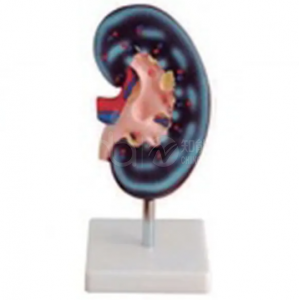
The BIX-A1079 is the whole-organ option: a 2× magnified kidney cut in the frontal plane, made in PVC on a plastic seat, showing the renal vessels, ureter, renal pelvis, medulla, cortex, pyramids and papillae in a 20 × 10 × 7 cm body. This comparison sets it against the glomerulus model (BIX-A1070 in the same range) so you can decide which to buy first.
| Question | BIX-A1079 whole-organ section | Single glomerulus model |
|---|---|---|
| What it shows | Cortex, medulla, pyramids, papillae, pelvis, ureter, renal vessels | One renal corpuscle and its capillary tuft |
| Best for | Gross anatomy, urine pathway, vascular supply | Filtration mechanics, filtration barrier |
| Typical course | Nursing, medical gross anatomy, biology | Physiology, histology support |
| Level of detail | Organ architecture | Cellular-scale structure, enlarged |
| Body size | 20 × 10 × 7 cm (2×) | Bench-top demonstration size |
Most syllabi introduce the kidney as an organ before they introduce the nephron as a unit. The BIX-A1079 matches that order: students trace blood in through the renal artery, see the cortex-medulla division, follow the pyramids into the calyces and out through the ureter. The frontal-plane cut is the reason it works — a mid-sagittal cut would hide the calyceal arrangement that the frontal plane exposes.
At 2× magnification the model is large enough for a group of four to see the papilla without crowding, and small enough to store in a drawer. PVC on a plastic seat is the standard construction for this price band: durable, cleanable, and not intended for repeated disassembly.
Work on renal physiology teaching found that a single, large, well-designed nephron representation helped students connect physiology, histology and pharmacology [1]. The lesson transfers: choose the model that lets several subjects be read on one object, and the same model keeps earning its place across the course.
The glomerulus model is the right first purchase only if your course is physiology-led and the organ has already been covered elsewhere. It shows the capillary tuft and the capsule at a scale no whole-organ model can, and it is the better tool for teaching filtration barrier selectivity.
Physiology teaching has also moved toward augmented and interactive representations of renal function, with measurable gains in comprehension when students manipulate the model rather than view it [3]. A glomerulus model lends itself to that treatment better than a static organ section.
Quotation and specification. Current pricing, packing and delivery for the BIX-A1079 are available from cprmodel@adaanatomy.com — quote both models if you are deciding between them.
Q1. What magnification is the BIX-A1079? 2×, in a body measuring 20 × 10 × 7 cm.
Q2. Which structures are shown? The frontal-plane section shows the renal vessels, renal pelvis, ureter, medulla, cortex, pyramids and papillae.
Q3. What is it made of? PVC, mounted on a plastic seat.
Q4. How is it packed? 50 × 35 × 42 cm carton, 20 units per box, 10 kg total.
Q5. Should we buy the glomerulus model instead? Only if gross kidney anatomy is covered elsewhere and your need is filtration mechanics. Most courses end up with both.
Q6. Does it show the nephron? No. It shows organ architecture; nephron detail requires a separate nephron or glomerulus model.
Product page: BIX-A1079 vs a Glomerulus Model: Choosing a Kidney Teaching Model That Fits — specification, packing data and a quotation request form.
For a quotation on the BIX-A1079, or to compare it with the glomerulus model, write to cprmodel@adaanatomy.com.