
Article tag: BMN/B025| sheep anatomy model| half-muscle veterinary model| large animal anatomy teaching| BMN/B027|
BMN/B025 sheep model versus BMN/B027 cat model: what each species teaches, which to buy for a first veterinary anatomy lab, and how to run both.
...
A veterinary anatomy store room rarely has unlimited budget, and the first two models most programmes argue about are the large ruminant and the small carnivore. The choice is not about quality — both are half-muscle, open-body teaching models — it is about which dissection your course cannot repeat with real material.
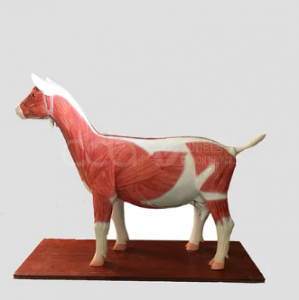
The BMN/B025 is the sheep: one half shows the superficial muscles, the other presents normal skin; the body separates into two removable parts so the main organs can be studied in situ and then lifted out. The BMN/B027 is the cat: a 12-part feline model sectioned along the midline, with one half showing muscle structure and removable internal organs. This comparison sets out what each does best.
| Feature | BMN/B025 sheep | BMN/B027 cat |
|---|---|---|
| Species | Sheep (large ruminant) | Cat (small carnivore) |
| Construction | Half muscle, half skin | Midline section, one muscle half |
| Part count | Body separates into 2 removable parts | 12 removable parts |
| Main use | Ruminant topography, superficial musculature | Detailed regional anatomy, organ relationships |
| Best course level | Undergraduate large-animal module | Detailed carnivore dissection module |
Ruminant topography is the argument. In a sheep, the forestomach compartments dominate the abdominal cavity and push every other organ into a position that students cannot predict from a dog or a cat. A model that shows the rumen, reticulum, omasum and abomasum in place — with the body wall removable — fixes that arrangement faster than a diagram.
The half-muscle, half-skin construction is also unusually efficient for a first practical: students see the superficial muscle layers on one side and the intact animal on the other, so they can relate surface landmarks to what lies beneath without changing models.
Large-animal teaching has a known weak point. Comparative courses that cover dogs, horses, sheep and rodents report that students generalise poorly across species unless the comparison is made explicit [1]. A sheep model used alone teaches sheep; a sheep model used next to a cat model teaches the principle.
The BMN/B027's 12 removable parts allow a slower, more detailed regional dissection. A cat's thorax and abdomen are compact, the organ relationships are tight, and 12 parts let a class work organ by organ without the model collapsing into an undifferentiated block.
For a programme whose clinical caseload is dominated by dogs and cats, the feline model maps more directly onto the cases students will see in clinics — and feline anatomy is the closer proxy for canine anatomy than any ruminant model will be.
Spatial-ability research in veterinary anatomy has argued that three-dimensional models are most valuable for students with weak mental rotation, and that the benefit disappears if the model is only demonstrated rather than handled [3]. Whichever species you buy, budget for enough units that students can touch them.
Quotation and specification. Current pricing, packing and delivery for the BMN/B025 are available from cprmodel@adaanatomy.com; ask for the BMN/B027 at the same time if you are comparing.
Q1. What is the difference between the two halves of the BMN/B025? One half displays the superficial muscles; the other shows normal skin.
Q2. Can the organs be removed? Yes. The body separates into two removable parts, allowing the main internal organs to be studied in place and then removed.
Q3. Is the BMN/B025 life-size? It is a sheep anatomical model built for laboratory demonstration; confirm the exact scale and dimensions with the supplier for your storage planning.
Q4. Which model suits a first-year course? The sheep, for ruminant topography and superficial musculature. The cat's 12-part construction is better suited to a more detailed second module.
Q5. Can both be used in one practical? Yes, and they should be if the syllabus is comparative — the differences are the lesson.
Q6. What should we order with them? A poultry model for a third vertebrate group, and a set of replacement organ pieces.
Product page: Sheep or Cat? BMN/B025 vs BMN/B027 for Veterinary Anatomy Labs — specification, packing data and a quotation request form.
For a quotation on the BMN/B025, or to compare it with the feline model, write to cprmodel@adaanatomy.com.