
Article tag: BIX-A1066| head anatomical model| trigeminal nerve model| mouth and throat anatomy| dental anatomy t|
BIX-A1066 review: whether a trigeminal-focused head model earns its place in a dental or oral anatomy course, and what it will not show.
...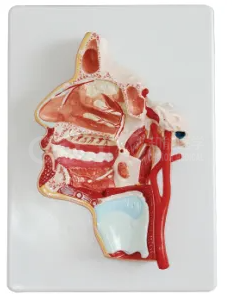
Most head models are built for the skull. The BIX-A1066 is built for the soft tissue — the internal structure of the mouth and throat, presented under the trigeminal nerve network. That makes it a specialist purchase, and specialists are exactly where procurement budgets go wrong.
This review sets out what the model is for, where it genuinely helps a dental or oral anatomy course, and the questions to ask before you buy it instead of a general head and neck model.
| Item | Detail |
|---|---|
| Model | BIX-A1066 head anatomical model |
| Focus | Internal structure of the mouth and throat |
| Neural overlay | Trigeminal nerve network |
| Format | Head model with exposed oral and pharyngeal structures |
| Intended use | Dental, oral and maxillofacial anatomy teaching |
| Compliance | ISO and CE certified |
The trigeminal nerve is the nerve students must know before they give an inferior alveolar block, and it is the nerve most often learned from a two-dimensional diagram of a lateral skull. The problem is that the diagram shows the branches but not the spaces they cross.
The BIX-A1066 takes the opposite approach: it exposes the oral and pharyngeal interior and lays the trigeminal network over it, so the branches are seen in relation to the structures a needle or a retractor will meet. For a course that teaches local anaesthesia or oral surgery, that relationship is the whole point.
Teaching literature on local anaesthesia supports model-based preparation: a simple anatomical model used to train inferior alveolar nerve block improved students' technique before they worked on patients, and models for learning anaesthesia techniques in oral surgery were reported as effective adjuncts [1][2].
If your objective is "students practise the block", buy a dedicated anaesthesia simulator. If the objective is "students understand why the block works where it does", this model is the better fit.
One caution: the model's value depends entirely on the labelling. A trigeminal overlay without a numbered key is a decorative object. Ask for the key in your teaching language before you order.
Buy it if you teach dental anatomy, oral surgery foundations, or speech and swallowing anatomy, and you want the trigeminal distribution shown in situ rather than on a chart.
Skip it if your course is general gross anatomy with a head and neck module — a standard head and neck model with vessels and nerves will cover more of your syllabus.
Quotation and specification. Current pricing, packing and delivery for the BIX-A1066 are available from cprmodel@adaanatomy.com.
Q1. What is the focus of the BIX-A1066? The internal structure of the mouth and throat, shown beneath the trigeminal nerve network.
Q2. Is it a full skull model? No. It is a soft-tissue-focused head model for oral and pharyngeal anatomy.
Q3. Can students practise injections on it? No. It shows relationships; it is not a procedure trainer with replaceable tissue.
Q4. Is it suitable for dental hygiene or nursing courses? Yes, particularly where oral anatomy and local anaesthesia foundations are taught.
Q5. Does it show the cranial nerves other than the trigeminal? The model is built around the trigeminal network; other cranial nerves require a dedicated head and neck nerve model.
Q6. What should we order with it? A skull model for osteology and a dedicated anaesthesia simulator if injection practice is assessed.
Product page: BIX-A1066 Head Model Review: Mouth, Throat and the Trigeminal Web — specification, packing data and a quotation request form.
For a quotation on the BIX-A1066, or to ask about the labelling key and detachable mandible, write to cprmodel@adaanatomy.com.